



Buy Used Electric Car from China to California: Import Guide
Buy Used Electric Car from China to California: The Ultimate Import Guide
The global electric vehicle (EV) market is undergoing a seismic shift, with China emerging as the undisputed powerhouse of production and innovation. For automotive enthusiasts, business importers, and eco-conscious drivers on the West Coast, the temptation to buy used electric car from china to california is growing stronger every day. With Chinese manufacturers like BYD, NIO, and XPeng offering cutting-edge technology at prices significantly lower than their Western counterparts, the arbitrage opportunity seems obvious.
However, importing a vehicle across the Pacific—specifically into the highly regulated state of California—is not a simple “click and ship” transaction. It involves a labyrinth of federal safety standards, environmental regulations, and complex logistics. Whether you are a dealership looking to expand inventory or an individual seeking a specific model, understanding the nuances is critical to avoiding costly mistakes.
This comprehensive guide will walk you through every step required to buy used electric car from china to california, covering sourcing, compliance, tariffs, and the specific challenges posed by California’s strict automotive laws.
The Appeal: Why Look to China for Used EVs?
Before diving into the logistics, it is essential to understand why so many buyers are looking to buy used electric car from china to california. The Chinese domestic market is flooded with EVs due to aggressive government subsidies over the past decade. As early adopters upgrade, the secondary market in China has become a treasure trove of high-quality, low-mileage electric vehicles.
- Price Advantage: Even with shipping added, the base price of a used Chinese EV is often a fraction of a comparable US market vehicle.
- Technological Variety: China offers micro-EVs, battery-swapping SUVs, and luxury sedans that are not available in the North American market.
- Battery Health: Due to advanced battery management systems (BMS) prevalent in Chinese tech, used EVs from the region often maintain excellent range retention.
However, the dream of a cheap import often clashes with the reality of American bureaucracy. If you intend to buy used electric car from china to california, you must navigate the trifecta of import authorities: The NHTSA, the EPA, and the infamous CARB.
Navigating Federal and State Regulations
The most significant barrier when you attempt to buy used electric car from china to california is not the distance; it is the law. Vehicles manufactured for the Chinese market (CN-Spec) are not built to comply with US Federal Motor Vehicle Safety Standards (FMVSS).
NHTSA and DOT Compliance
The National Highway Traffic Safety Administration (NHTSA) enforces safety standards. A car built for China generally lacks specific US-mandated safety features, such as specific airbag calibrations, lighting standards, and structural reinforcements. To legally register a vehicle for road use, it must be “federalized.” This process requires a Registered Importer (RI) to modify the vehicle to meet US standards, which can be prohibitively expensive—often costing more than the car itself.
The California Difference: CARB Compliance
If your destination is California, the challenge intensifies. The California Air Resources Board (CARB) has standards that exceed federal requirements. While EVs produce zero tailpipe emissions, the vehicle’s system must still be certified to ensure it meets on-board diagnostic (OBD) and battery durability standards recognized by the state.
When you prepare to buy used electric car from china to california, you cannot simply bypass CARB. California DMV will not register a vehicle imported from overseas unless it has a specific emissions label or a certificate of conformity, even if it is electric. This makes the role of a specialized customs broker and compliance expert non-negotiable.
Sourcing Your Vehicle: B2B and Auctions
Once you have a compliance strategy (or if you are importing for “Show and Display” or off-road use), the next step to buy used electric car from china to california is sourcing. The Chinese used car market operates differently than the US market.
Reliable Platforms
Most international buyers utilize B2B platforms rather than consumer sites. Alibaba is the most famous, but specialized automotive export platforms usually offer better verification services. When vetting a supplier, look for:
- Export Licenses: The supplier must be authorized by the Chinese Ministry of Commerce to export used vehicles.
- Inspection Reports: Demand third-party inspection reports detailing battery health (SOH), tire condition, and chassis integrity.
- Video Verification: A reputable seller will provide a live video walk-around of the specific VIN you intend to purchase.
Logistics: Shipping from China to the West Coast
The logistics of moving heavy lithium-ion batteries across the ocean are complex. When you arrange to buy used electric car from china to california, you are shipping “Dangerous Goods” (Class 9) due to the batteries.
Ro-Ro (Roll-on/Roll-off) vs. Container
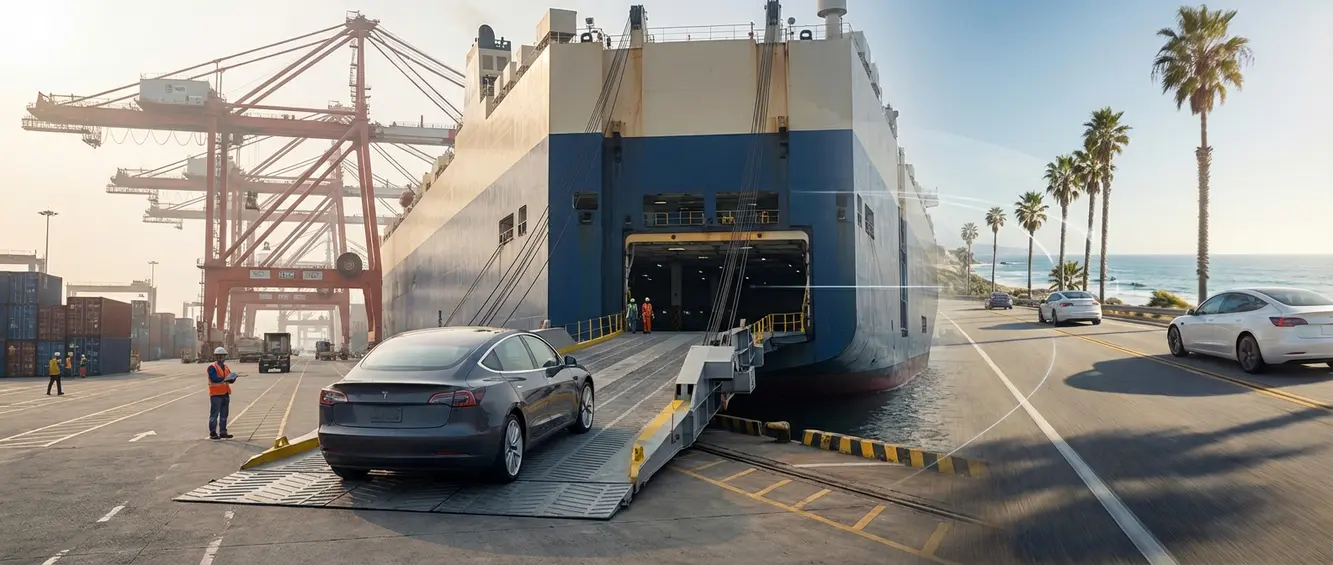
Ro-Ro shipping is typically the most cost-effective method for vehicles. The car is driven onto the ship in Shanghai or Shenzhen and driven off in Long Beach, Oakland, or Port Hueneme. However, Ro-Ro carriers have strict rules regarding EVs; the battery state of charge (SoC) usually must be between 20% and 50% for safety reasons.
Container shipping offers more protection and allows you to ship spare parts or charging equipment alongside the vehicle. If you plan to buy used electric car from china to california in a small volume (e.g., 2-3 cars), a 40-foot container is often the best choice to prevent salt water damage and theft.
The Financial Reality: Tariffs and Duties
You cannot discuss the plan to buy used electric car from china to california without addressing the trade war tariffs. The geopolitical landscape heavily influences the final cost.
Traditionally, cars imported to the US faced a 2.5% duty. However, under Section 301 tariffs established during the trade disputes and reinforced by subsequent administrations, Chinese-made automobiles face a significant additional tariff. Recently, the US government signaled intent to raise tariffs on Chinese EVs to 100% to protect domestic industry. While this largely targets new vehicles, used vehicle importers must carefully classify their imports to determine the exact duty rate.
Furthermore, you will need a Customs Bond. Since the value of an EV plus the high tariffs will exceed $2,500, a formal entry is required. This bond acts as an insurance policy for the US government ensuring all duties are paid.
Technical Hurdles: Charging Compatibility
A practical issue often overlooked when people decide to buy used electric car from china to california is the charging port.
China uses the GB/T standard for both AC and DC charging.
The US uses J1772 (AC) and CCS1 or NACS (DC).
You cannot plug a Chinese EV into a Tesla Supercharger or an Electrify America station in California without a specialized, high-quality adapter. While adapters exist, they can be expensive and may limit charging speeds. In some cases, importers choose to retrofit the vehicle’s charge port, a complex electrical job that should only be handled by high-voltage certified technicians.
Step-by-Step Import Checklist
To summarize the workflow to buy used electric car from china to california, follow this checklist:
- Verify Eligibility: Check if the specific Make/Model is on the NHTSA list of non-conforming vehicles eligible for import, or prepare for the high cost of a Registered Importer.
- Secure a Supplier: vet Chinese exporters with valid licenses.
- Calculate Total Landed Cost: (Car Price + Shipping + Insurance + 27.5% to 100% Duty + RI Modification Costs).
- Hire a Customs Broker: Do not attempt to clear an EV through US Customs yourself.
- Arrange Shipping: Ensure the carrier accepts EVs and verify insurance coverage.
- File ISF (10+2): Your broker must file the Importer Security Filing at least 24 hours before the ship leaves China.
- Arrival & Modification: The car moves to a bonded warehouse or RI facility for modifications (if intended for road use).
- Registration: Once federalized, take the paperwork to the California DMV for registration.
Risks and “Grey Market” Warnings
There is a thriving “Grey Market” where sellers claim you can easily buy used electric car from china to california and register it as a “Low Speed Vehicle” (LSV) or “Neighborhood Electric Vehicle” (NEV). While this is possible for certain small carts, attempting to register a full-sized highway-capable EV (like a BYD Han) as an LSV is illegal and can lead to the vehicle being seized and crushed by Customs.
Always prioritize transparency. If a deal sounds too good to be true—for example, a $10,000 modern electric SUV landed in Los Angeles—it likely involves fraud or illegal importation tactics that will leave you with a vehicle you cannot drive.
Conclusion
The decision to buy used electric car from china to california is one for the bold and the well-informed. The financial incentives of low Chinese market prices are substantial, but they are counterbalanced by high tariffs, strict safety regulations, and the unique hurdles of California’s DMV.
For B2B buyers, the opportunity lies in niche vehicles, off-road utility EVs, or parts sourcing. For individuals, the process requires patience and deep pockets for compliance. As the global automotive landscape evolves, cross-border EV trade will likely become more streamlined, but for now, due diligence is your most valuable asset.
If you are ready to navigate these waters, ensure you have a team of logistics and compliance experts by your side. Successfully executing a plan to buy used electric car from china to california can yield a unique, high-tech vehicle that stands out on the Pacific Coast Highway, provided you follow the rules of the road—and the government.
Frequently Asked Questions
1. Is it legal to buy used electric car from china to california for daily driving?
Yes, but only if the car is “federalized.” This means it must be modified by a Registered Importer to meet US safety (DOT) and EPA standards. Simply shipping a standard Chinese-spec car and driving it on California roads is illegal without these modifications.
2. How much does it cost to ship a car from China to California?
Shipping costs vary based on current freight rates and the method used. Generally, Ro-Ro shipping can range from $1,500 to $3,000 per vehicle, while a dedicated container can cost between $4,000 and $8,000. However, when you buy used electric car from china to california, you must also factor in the 25%+ tariffs and customs bond fees.
3. Can I charge a Chinese EV in California?
Chinese EVs use the GB/T charging standard, which is different from the J1772 and CCS/NACS standards used in the US. You will need to purchase a GB/T to Type 1 (J1772) adapter for home charging and a GB/T to CCS adapter for fast charging, or have the charging port professionally replaced.
4. Does the $7,500 tax credit apply if I buy used electric car from china to california?
No. The US federal tax credit for used EVs applies only to vehicles purchased from licensed US dealers for cars that have already been registered in the US. Furthermore, the Inflation Reduction Act has strict requirements regarding battery component sourcing that imported Chinese vehicles generally do not meet.
🚗 Looking to Import Cars from China?
Qicheng Car specializes in exporting Chinese used cars and new energy vehicles to Africa and the Middle East. We support wholesale orders, vehicle inspection, and international shipping.
- 🔹 Wholesale Inquiry:
Request Export Pricing
- 🔹 Available Vehicles:
View Used & Electric Cars
- 🔹 Why Choose Us:
Learn About Our Export Experience